
A few posts ago, I discussed the fact that—absent a change—complete weight regain is the usual expectation for those who discontinue treatment with injectable weight-loss medicines. Only a small number of clinical trials involving these meds put in the effort to track patients after the treatment phase ended. The few that did failed to follow participants long enough to understand the weight-regain story.
There is a huge amount of interest in finding a way to maintain weight loss from Zepbound and Wegovy therapy after the drugs are stopped. Personally, I think maintaining long-term weight loss after stopping the meds will prove impossible.[i] It is also interesting to me that we care about it. I mean, nobody is wracking their brains searching for ways to keep cholesterol down after stopping Lipitor.
We just take Lipitor. The strange urgency to escape applies only to obesity medication. This phenomenon seems like evidence that, alas, there is still a stigma attached to obesity and obesity treatment. For some reason, we can’t stop regarding obesity as different from other chronic health problems.
In any event, nobody has yet figured out how to do it.[ii] Nonetheless, some of the strategies that have been tried so far are worth looking at. Besides being interesting in and of themselves, they also provide an opportunity to see why it’s important to dig into the details of clinical studies. “Reading the fine print” as such is necessary to know whether the study’s conclusions are believable.[iii]
Dose Tapering
Dose tapering (“weaning”) is the idea that you can discontinue weight-loss medication without total loss of effectiveness if you withdraw it very, very slowly. Is it logical that it would work? Not really. It’s reminiscent of a stand-up bit by comedian Sebastian Maniscalco, wherein he describes how he uses a “soft release” when placing too-heavy luggage on the scale at the airport. He points out the humorous absurdity of trying to trick a scale into thinking a bag doesn’t weigh what it weighs. Normally, we reduce the dose of medicine when we want less effect, not when we want it to stay the same.
Even though tapering to zero is talked much about, no prospective clinical trials have tested it. I found a single retrospective study[iv] out of Denmark in which the authors initially claimed[v] to have successfully tapered some 240 people down to zero, without subsequent weight regain[vi], by using the study sponsor’s proprietary app (Embla™). The authors presented their taper data at the European Congress on Obesity, in 2024. At the conference, they presented data showing that they tapered 240 patients down to zero semaglutide with no weight regain. These tapered-to-zero patients were followed for 26 weeks, during which they did not exhibit weight regain. At the end of 26 weeks, a bunch of them went back on semaglutide. The reasons they resumed medication were not given.
Twenty-six weeks is only six months, which is a fleeting time considering the usual scope of weight-loss trials. We know from clinical trials of intensive lifestyle-modification programs (think “boot camp”-like programs) that it’s possible to browbeat a group of people into losing significant amounts of weight for six months.[vii] The Embla company obviously had a lot to gain by demonstrating successful taper, and it’s not difficult for me to imagine the patient-facing staff being highly motivated—perhaps even financially compensated—to cajole, bribe, and harry their assigned patients across the finish line at the desired weight. The fact that many of those patients resumed semaglutide as soon as they were allowed reinforces the idea that there was some kind of “race to the finish line” going on there, but who knows.
Despite the short duration and general sketchiness of the taper arm, in a press release Embla ApS put out at the time, the Chief Medical Officer, Dr. Henrik Gudbergsen, declared, “The combination of support in making lifestyle changes and tapering seems to allow patients to avoid regaining weight after coming off semaglutide.”[viii] Dr. Gudbergsen’s statement gives the impression that tapering unequivocally works, maybe even in the long term. In any event, he sure didn’t go out of his way to highlight the bad news—the short duration of the supposedly successful tapering experiment and many participants’ prompt return to semaglutide after 26 weeks.
Now, the Embla ApS corporation may be a bunch of fine, ethical fellows. I don’t have grounds to assert otherwise. But, I will say that it pays to be suspicious of studies that are funded by corporations with an obvious interest in a particular outcome. That warning goes double when such studies unexpectedly find the desired outcome. I don’t think this trial should be taken as evidence that successful taper in real-world conditions is possible.
Tapering by Increasing the Time Between Doses
A few trials have looked at slowly increasing the time interval between doses, which is also tapering of a sort. One study out of San Diego looked at stretching out the time between doses for a group of semaglutide and tirzepatide patients that had purportedly reached a weight-loss plateau.[ix] Some thirty patients successfully maintained weight loss on net lower doses of their respective meds by reducing the dosing frequency. None of them actually got off the medication completely,[x] but the authors concluded that the study offers “proof of concept” for the idea that tapering to a lower dose without loss of effect is possible.
Unfortunately, the study has a major flaw, one which prevents us from accepting that conclusion at face value. Specifically, the investigators’ definition of “plateau” is unconventional in the extreme. They defined a plateau as when there has been “less than 5% variation [in weight] over a 3-month period.” Their definition conforms neither to the dictionary definition of “plateau” nor its customary meaning in obesity medicine.
The essential feature of a plateau is flatness. A plateau is flat. According to the Cambridge Dictionary, to plateau means, “to reach a particular level and then stay the same.”[xi] [emphasis added] Cambridge Dictionary also offers a surprisingly relevant example of plateau used in a sentence: “I’d been losing about a pound a week on my diet, but recently I’ve plateaued and haven’t lost an ounce.”
Cambridge Dictionary clearly believes that losing a pound a week is not a plateau. I agree. The study definition of plateau, in contrast, applies to lots of patients who are losing a pound a week, or even more. (You’ll see I’m talking about patients who started above 260 pounds, if you care to do the math.[xii])
Looking at graphical results from another semaglutide trial will help illustrate why declaring plateau too early made it impossible to assess whether tapering succeeded. The figure below is from a study that mathematically modeled how different dosing intervals would impact the weight-loss results. The model is based on what is known about the medications’ dose-response curve from prior clinical studies. The black dots denote the actual, real-life study data, semaglutide (circles) versus placebo (squares). The blue line represents patients who continued the usual seven-day dosing schedule. The green, purple, and brown lines reflect changing to 10, 14, and 28-day dosing intervals, respectively.
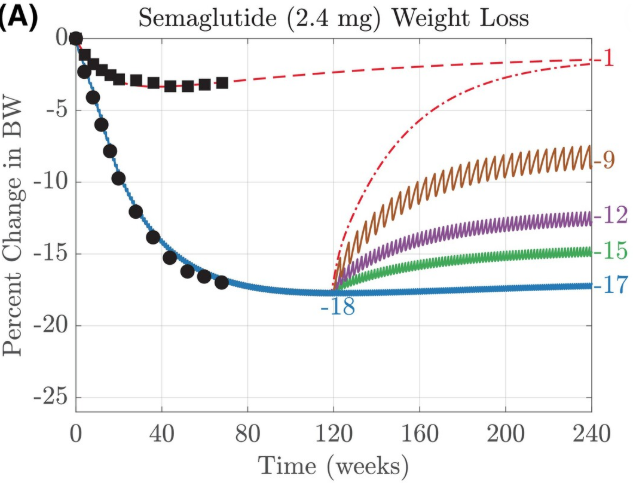
Before I talk about what it means for the tapering question, the figure has another point of interest. Observe the black squares, which represent the average weight lost at different points by the placebo group. The average weight loss of the placebo guys was significant, maybe 3.5% of their body weight, with no medication. How did that happen?
It happened because the placebo patients were engaged in the very robust and rigorous diet program that is part of every obesity medication trial. Pharmaceutical companies (e.g., Eli Lilly) must conduct clinical trials to get new drugs approved by the FDA. They want their FDA trials to show the best results possible, because drug makers are constrained by federal law (historically, anyway) to use only the FDA trial data in future drug advertising. Since they’re going to be stuck with a number, they want it to be a good number.
It’s well known that intensive diet programs by themselves can temporarily achieve 3-4% total body weight loss (on average). Aware of this fact, drug makers design trials that will tack that extra 3-4% onto their own headline weight-loss number. Clinical trial design for weight-loss meds therefore inevitably includes a very rigorous follow-up and support regimen for both the treatment and placebo arms. It’s usual for patients to meet weekly or even more often for a weigh-in and one-on-one counseling with a team that includes dietitians, psychologists, exercise physiologists, support groups, life coaches, etc.[xiii]
Okay, back to the subject of plateauing too soon. Now, look at the same figure into which I added a line (red) that indicates the point at which the study group meets the 5% plateau definition, and a line (green) that indicates where the true plateau is:
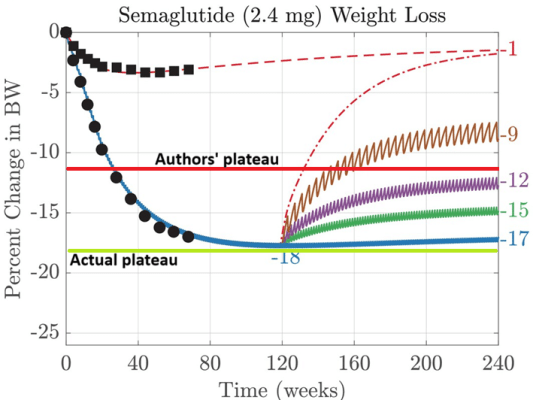
The authors declared “plateau” at a time when the patients had fully 1/3 of their expected weight loss to go. It should surprise no one that doubling the dosing interval at that time would cause patients to stabilize around that weight. The purple curve shows that stabilization just under that “plateau” is precisely what the model predicted for a 7-day to 14-day dosing adjustment.
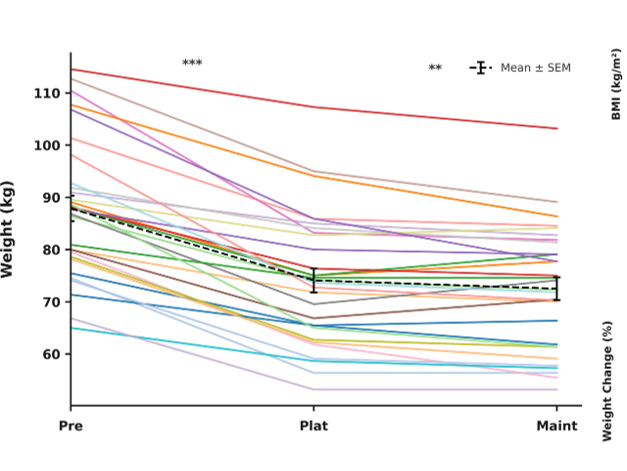
The tapering-study authors provided their own graphical data, but it’s less useful. Their graph only includes data from three specific study events: before starting high dose medication, upon reaching the so-called plateau, and after tapering. They did not provide patient weights at multiple data points, which is usual for weight loss trials, nor did they say anything about how much time elapsed between the events. Here is their graph:
The authors concluded:
“Our findings demonstrate that many patients who initially lose weight on standard weekly GLP1 therapy maintain weight, body composition, and metabolic parameters after transitioning to reduced-frequency dosing. This study provides early proof of concept that structured de-escalation may be a viable strategy to sustain benefits while reducing treatment burden.”
I disagree with their conclusion, because they did not provide proof that structured de-escalation works. They de-escalated from a high-dose of medication, but they didn’t show that those patients sustained high-dose levels of effectiveness. To do that, they would have to have demonstrated that their patients achieved high-dose effectiveness (a bona fide plateau) and they didn’t do that either. In fact, the study’s unusual design—the odd definition of “plateau,” choosing to report only three data points, omitting any mention of the duration of the study phases or the time interval between them—seems suspicious. One might infer from the authors’ choices that they intended to obfuscate the fact that the study population did not reach a true plateau on high-dose medication. Such an inference wouldn’t take much of a stretch, anyway.
For me, the most interesting takeaway from the study was the awareness among its authors of the fact that patients don’t like depending on medication to maintain weight loss. It was acknowledged directly in the discussion:
“Although continued maintenance of health outcomes despite reducing therapy is a high standard for any medication, it remains the most common question we receive from patients initiating GLP1 treatment: ‘Will I have to take this forever?’ The lack of evidence-based guidance contributes to hesitancy. Notably, similar questions are rarely asked about other long-term medications such as antihypertensives or hormone replacements. Few patients expect to take blood pressure medication only a few days per week or to discontinue thyroid or testosterone therapy once stabilized.”
Patients are indeed more comfortable taking weight-loss medication when they have room to believe that they could succeed without it, even if they have no plans to test that belief. Here, the authors did not truly evaluate tapering. They seem more interested in testing the hypothesis that patients would be satisfied with less weight loss if they believed they achieved it by successfully tapering down from the maximum dose of a medication.
[i] Obesity has been studied as thoroughly as any other disease in medicine. There are more than ten thousand clinical trials looking at obesity treatments from the era predating the injectable medications. Most of those treatments involve a diet of some kind combined with some other therapeutic intervention, like medication, cognitive-behavioral therapy, hypnosis, etc. If you spend an afternoon perusing those studies, you’ll see that (1) there are a host of different diets that help obese people lose weight temporarily, and (2) the number of trial participants that are below their starting weight three years into the trial is almost zero.
[ii] I’m not sure it’s rational to expect to find a way to extend these drugs’ effectiveness after they are stopped. I mean, nobody has suggested it’s possible to sustain the effects of any other drugs after they are discontinued. It may be a fool’s errand.
[iii] Sometimes they are baloney.
[iv] Seier S, Stamp-Larsen K, Jensen SBK, Torekov SS, Gudbergsen H. Treat to target in weight management with semaglutide: Real-world evidence from an eHealth clinic. Diabetes Obes Metab. 2025 Dec;27(12):6979-6987. doi: 10.1111/dom.70096. Epub 2025 Sep 3. PMID: 40903862; PMCID: PMC12587240.
[v] The authors initially presented this study at the European Congress on Obesity in 2024, at which time they presented data showing that they tapered 240 patients down to zero semaglutide with no weight regain. When the study results were published in a peer-reviewed journal in 2025, the mention of patients successfully tapered off medication had been removed.
[vi] For just twenty-six weeks.
[vii] Think “The Biggest Loser.” The problem with intensive or immersive lifestyle-mod programs is that eventually everybody has to return to real life. When they stop living the bootcamp lifestyle, regain occurs.
[viii] He surely didn’t go out of his way to communicate the narrow, time-limited conditions under which weight regain had seemingly been avoided.
[ix] Wong M, Wu A, Garhe PK, Biermann M. Reduced-Frequency GLP1 Therapy Maintains Weight, Body Composition, and Metabolic Syndrome Improvements: A Case Series. Obesity (Silver Spring). 2026 Feb 24. doi: 10.1002/oby.70137. Epub ahead of print. PMID: 41732031.
[x] In interval speak, stopping the medication entirely means the dosing interval is infinity.
[xi] “Plateau.” Cambridge Dictionary, Cambridge University Press, https://dictionary.cambridge.org/us/dictionary/english/plateaued. Accessed 15 May 2026.
[xii] The authors say losing less than 5% in a quarter indicates a plateau. Well, 5% of 260 pounds is 13 pounds. Losing a pound a week for three months would total just under 13 pounds of weight loss. Plateau!
[xiii] When I said that it was possible to browbeat patients into modest weight loss without medicine (at least for a while), this is what I was talking about.