
Because injectable weight loss medications are so highly effective and have become so widespread, a lot of Americans are losing a whole lot of weight. Economists have been investigating the likely effects of all that weight loss, and some of it is fascinating.
For instance, lighter passengers may mean lower fuel bills for commercial airlines. Jefferies, an investment bank, predicted that the average passenger weight will fall enough to result in many millions of dollars a year in savings. United Airlines alone stands to save some 90 million dollars a year.1
Some of the more interesting studies have to do with how GLP-1s impact household spending on things like food, clothing, and alcohol. Those are the ones that we’re going to look at more closely.
Several studies have looked at what happens to the grocery bill when someone in the household starts taking a GLP-1. The bottom line is pretty consistent: those households spend about 5% less on groceries within six months, and most of the cut comes from snacks, sweets and soda. Patients on Wegovy, Ozempic, Zepbound and Mounjaro buy less food, it seems.
The largest study: 5.3% less in six months
The biggest study so far comes from Cornell University and the consumer-data firm Numerator, published in the Journal of Marketing Research. Researchers matched survey answers about GLP-1 use with actual purchase records from tens of thousands of US households. They then compared spending before and after a household member started the medication.
- Groceries fell 5.3% in the first six months and stayed about 4% lower in months 7 to 12.
- Higher-income households cut more: more than 8%.
- Eating out fell too: spending at fast-food chains and coffee shops dropped about 8%.
- Weight-loss users cut slightly more than people taking the drug for diabetes (5.6% vs 4.6%).
Other tracking firms report similar numbers. A 2026 PwC analysis of Numerator data put the per-household grocery drop at 5.5%.
GLP-1 users choose different food
The cuts land hardest on snacks and sweets, and only a handful of healthier categories go up.
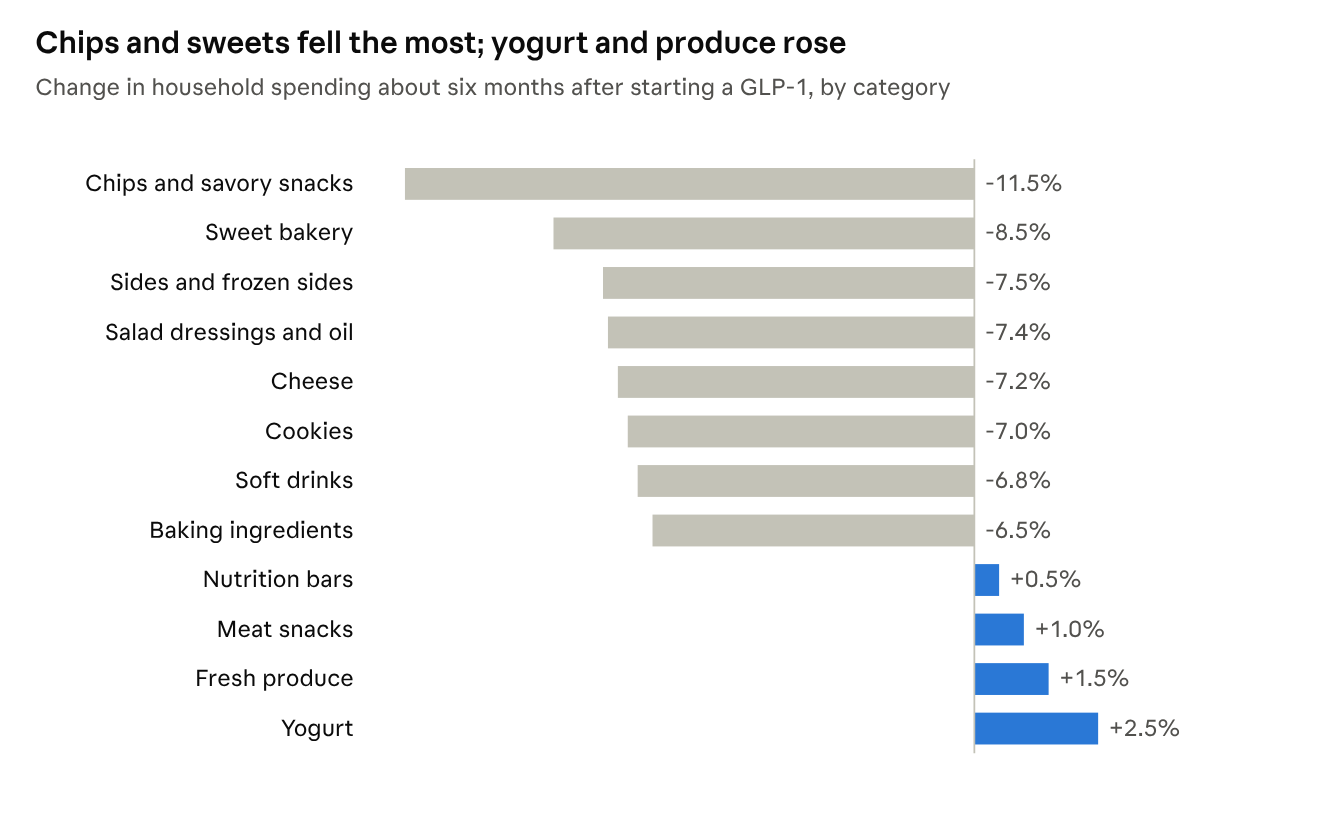
Even staples like bread, meat and eggs declined. The small increases in yogurt and fresh produce showed up only among people taking the medication for weight loss.
A Danish study in JAMA Network Open looked at nutrition rather than dollars. Researchers analyzed nearly 2 million supermarket receipt lines from 1,177 adults, 293 of whom started a GLP-1. Afterward, their carts held fewer calories, less sugar, less saturated fat and fewer carbohydrates, with modestly more protein. Ultra-processed foods made up a smaller share. People who did not start the medication drifted slightly the other way.
Do the changes last?
For the most part, they do—as long as patients stay on the medication.
- The effect fades a little. In the Cornell data, households who stayed on the drug kept spending less for at least a year, but the gap narrowed.
- Stopping undoes it. When households stopped the medication, grocery spending rebounded. About a third of households in the study stopped during the observation period.
- Healthier choices may not stick on their own. A small Swiss study of 56 patients used supermarket loyalty-card data. Purchases shifted toward protein, fiber, fruit and vegetables at 5 months. By 10 months they looked much like they did before treatment.
- Treats return in year two. Circana tracked US households from 2023 to 2026. Grocery spending stayed below its pre-treatment level into the second year. Restaurant spending dipped in year one, then nearly recovered. Candy and frozen desserts rose above baseline by year two.
The medication turns down appetite and cravings. It does not, by itself, build the eating habits that keep weight off.
The return of interest in sweets is unfortunate, but we see the same thing happen among bariatric patients. I have my suspicions about why it happens, but we do not know for certain.
Beyond the grocery store: clothes and alcohol
Some of the money saved on food moves to the clothing rack, and less of it goes to drinks.
Clothing spend goes up. PwC found apparel spending rises 9.9% after 6 to 8 months on a GLP-1, and 73% of users it surveyed reported a meaningful change in clothing size. Circana found clothing spending kept climbing into the second year of treatment. GLP-1 users will need some new clothes, it seems.
Alcohol spend goes down. In the UK, households with a GLP-1 user cut alcohol spending by 15%, according to Worldpanel by Numerator. Two small randomized trials point the same way. In one, weekly semaglutide injections reduced drinks per drinking day and alcohol cravings in adults with alcohol use disorder. In the other, oral semaglutide reduced heavy drinking days. Larger trials are still needed. These drugs are not FDA-approved to treat alcohol use disorder—not yet, at any rate.
Is there a takeaway if you’re on a GLP-1?
When you eat less, each meal has to do more work. That is where most patients need help.
- Put protein first. GLP-1 weight loss includes some loss of lean muscle. Adequate protein plus strength training can help protect it.
- Keep the savings in perspective. A 5-6% smaller grocery bill is obviously good news, but unless you have truly great insurance, it likely won’t cover the cost of the medication.
- Be vigilant about sugar consumption. It often creeps back in around year two, but it doesn’t have to. Try to maintain your resolve to stay away completely. A single serving of something sweet will provoke powerful cravings for sweets in the future. Sweets are not our friends!
Our registered dietitian (Suzanne) helps patients plan meals that fit a smaller appetite. Even if you get your GLP-1 prescribed elsewhere, you are welcome to make an appointment.
References
- Hristakeva S, Liaukonytė J, Feler L. The No-Hunger Games: How GLP-1 Medication Adoption Is Changing Consumer Food Demand. Journal of Marketing Research. 2025. Category-level figures are from the 2024 working paper.
- Sørensen KK, et al. Consumer Food Purchases After Glucagon-Like Peptide-1 Receptor Agonist Initiation. JAMA Network Open. 2026;9(1):e2555449.
- Orban F, et al. Digital Food Purchase Signatures and Their Response to GLP-1-Based Treatment in People With Obesity. Diabetes, Obesity & Metabolism. 2026.
- PwC. The end of more: How GLP-1 users shop, eat, and seek support. 2026.
- Circana. New Circana Research Reveals GLP-1 Consumers Are Resetting Spending Habits, Not Just Reducing Them. November 10, 2026.
- Worldpanel by Numerator UK data, as reported by Just Food and Just Drinks. November 2026.
- Hendershot CS, et al. Once-Weekly Semaglutide in Adults With Alcohol Use Disorder: A Randomized Clinical Trial. JAMA Psychiatry. 2025;82(4):395-405.
- Schacht JP, et al. Oral Semaglutide for Alcohol Use Disorder: A Randomized Clinical Trial. American Journal of Psychiatry. 2026;183(9):636-645.
- Beaudart C, et al. GLP-1 Receptor Agonists and Musculoskeletal Outcomes: A Systematic Literature Review and Meta-Analysis. Drugs. 2026;86(10):1661-1691.