
Gastric Bypass or Gastric Sleeve? Comparing Two Popular Options
Accuracy of the medical content was verified by Dr. Matthew Fitzer, M.D., FACS, FASMBS, a board-certified bariatric surgeon. (He authored most of it.) Read Dr. Fitzer's professional bio
Laparoscopic Roux-en-Y gastric bypass and laparoscopic sleeve gastrectomy are the most performed weight loss operations in the United States. They have several similarities: both are done through small incisions, both usually require a one-night hospital stay, and both are far safer than most people expect.
If you are asking yourself, “Which is better?” the honest answer is that neither is better for everybody — they are different tools. Choosing the right one depends on your health history, your medications, and what you want your life to look like afterward.
How do the bypass and sleeve actually make you lose weight?
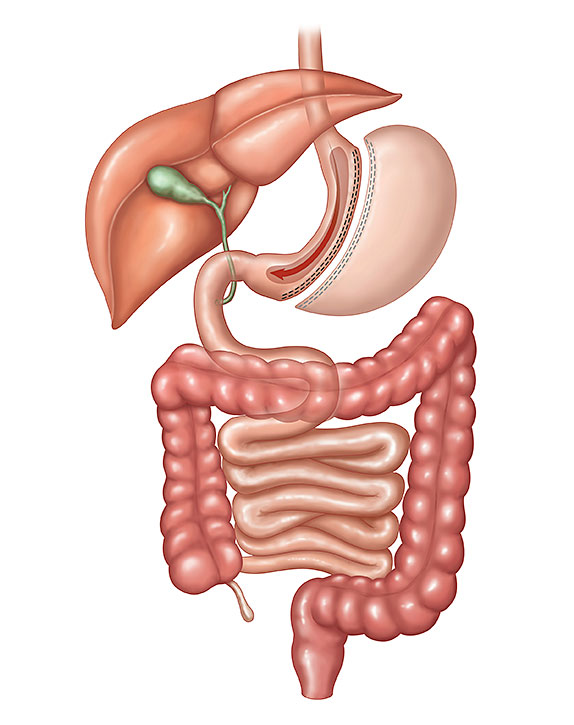
During a sleeve gastrectomy, the surgeon uses a surgical stapling device to remove roughly 75 to 80 percent of the stomach. What remains is a sealed, tube-shaped stomach that is pretty close to the size and shape of a standard banana.
Nothing is rerouted. The intestines aren’t touched. You eat less because the new stomach holds less, and you feel less hungry because the part that came out is what manufactured most of your body’s ghrelin, a hunger hormone.
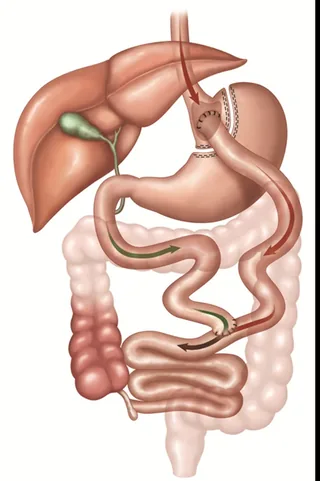
In a gastric bypass, the surgeon uses the same stapler to create a small stomach pouch — about the size of an egg. The pouch is then connected directly to the small intestine. After surgery, food “bypasses” the larger part of the stomach, plus a small stretch of intestine.
The pouch is the part that is critical for weight loss. Like the tubular stomach you get with a sleeve,[1] a small bypass pouch limits how much you eat by sending nerve signals to your brain. It also sends a hormonal signal to the brain and pancreas, the end result of which is a sensation of fullness and better blood sugar control.[2]
How gastric bypass and sleeve gastrectomy compare, side by side
| Sleeve gastrectomy | Gastric bypass | |
|---|---|---|
| What happens | About 75–80% of the stomach is removed, leaving a narrow tube. Intestines are untouched. | A small pouch is made and connected directly to the small intestine, bypassing the rest (90–95%) of the stomach and the duodenum. |
| % Excess body weight loss.* | 67 to 79% | 70 to 79% |
| Diabetes | Strong improvement; remission in many patients | Somewhat higher and more durable remission rates |
| Reflux (GERD) | Can worsen existing reflux or cause new reflux | Usually improves reflux; the preferred option if GERD is a problem |
| Operating time | Roughly 45 minutes, one staple line | Roughly 1 hour, two connections |
| Vitamins | Lifelong supplementation | Lifelong supplementation |
| Main long-term risks | Reflux, sleeve dilation, weight regain | Marginal ulcer, dumping syndrome, nutrient deficiency, internal hernia |
* The ranges reflect Dr. Fitzer's MBSAQIP patient follow-up data.
How does weight loss hold up in the longer term?
If you peruse the relevant medical literature, you will see variations of the following. Through the first few years, the two procedures usually perform similarly. The gap opens up after four or five years.
In long-term randomized trials that followed patients for a full decade, bypass patients had modestly greater weight loss than sleeve patients — for example, 65 percent versus 61 percent of excess BMI lost in one Swiss trial — and sleeve patients were more likely to need a second operation for inadequate weight loss. Those are averages, though. The variation between individuals having the same operation is much larger than the average difference between the two operations.
Here is how Dr. Fitzer’s own patients have done. The first chart shows ten-year excess weight loss after gastric bypass; the second shows the same measure after sleeve gastrectomy.


Type 2 diabetes: bypass edges out the sleeve
Both procedures improve blood sugar dramatically, often right away, before meaningful weight loss has occurred. Bypass tends to edge out the sleeve in diabetes control. In a carefully controlled Norwegian trial, half of bypass patients had an HbA1c under 6.0 percent five years later, compared with a fifth of sleeve patients.
Surgeons often lean toward bypass for patients who have had diabetes for many years, who use insulin, or whose blood sugar has been difficult to control. Remission is not the same as cure — diabetes can return, especially with weight regain — but many people spend years or decades off medication. Some never return to it.
Reflux: a clear difference between the two operations
This is where the two operations genuinely differ, and it’s a factor that is often underweighted by patients: the sleeve has a bit of a reflux problem. If you have reflux, getting a sleeve often worsens it. For people without reflux, a sleeve will install reflux bad enough to require a daily pill in some 10 to 20 percent of them. Occasionally the reflux is quite severe. Around 5 percent of sleeve patients eventually seek conversion to a bypass specifically for relief from heartburn.
Gastric bypass, by contrast, is the most reliable anti-reflux operation in bariatric surgery. Improved or resolved heartburn is the norm.
If you already take a daily proton pump inhibitor (any heartburn medicine ending in “-prazole”), or have a hiatal hernia, or have been diagnosed with Barrett’s esophagus, expect your surgeon to nudge you toward bypass. If reflux has never been an issue for you, this consideration carries much less weight.
How safe are gastric bypass and sleeve gastrectomy?
Both operations are very safe. In the large, national databases, thirty-day mortality averages one to two patients in a thousand — on par with gallbladder surgery and lower than hip replacement. Those same databases put serious complication rates at around one percent for the sleeve and modestly higher for the bypass, reflecting the extra complexity.
Each has its own signature risks: staple line leak and stricture for the sleeve; marginal ulcer and internal hernia for the bypass, the latter of which can appear years down the road. It’s why bypass patients are taught not to delay medical evaluation for abdominal pain.
Living in harmony with your chosen procedure
Surgery is a tool, not a finish line. Both operations commit you to lifelong habits, but the specifics differ:
- Vitamins. Both require daily supplements for life. Bypass is more demanding: B12, iron, calcium citrate, vitamin D, and a bariatric multivitamin, with regular blood work. Skipping them causes deficiencies that can take years to show up and can be permanent.
- Medications. After bypass, over-the-counter NSAIDs such as ibuprofen and naproxen are generally off-limits because of ulcer risk. There may be a minor increase in ulcer risk in sleeve patients, but once they are several months out from surgery, most can take NSAIDs without any problems.
The sleeve leaves the intestinal route intact, which matters if you take drugs with narrow dosing windows, such as transplant medications.
Absorption is also affected. A few medicines have been observed to have modestly reduced absorption after gastric bypass.
- Eating. Bypass patients may experience dumping syndrome — cramping, flushing, and diarrhea after sugary or fatty foods. Unpleasant, but many people find it a useful guardrail. Sleeve patients rarely get this.
- Alcohol. Both procedures raise blood alcohol faster; bypass carries a modest increase in risk of alcohol use disorder.
- Weight regain. Minor regain after the two-year mark is normal and expected. Meaningful regain affects a minority. Attending follow-up appointments is one of the strongest predictors of keeping the weight off, and modern weight-loss medications now give clinicians an option if regain occurs. See our guide to managing weight regain after bariatric surgery.
Which operation is reversible — the sleeve or the bypass?
A sleeve operation entails removal of most of the stomach, which is an organ we can’t “save for later.” It’s permanent. A bypass can technically be reconstructed or “reversed,” but rarely is. The one useful asymmetry: a sleeve can be converted to a bypass later if reflux or weight regain becomes a problem, and this is a well-established path — see our page on revisional bariatric surgery. A bypass has only reversal.
Questions worth bringing to your consultation
Ask your surgeon how often they perform each operation and what their own complication and revision rates look like. Ask specifically how your reflux history, your diabetes, your current medications, and any prior abdominal surgery point toward one option.
Ask what the follow-up schedule looks like at five and ten years, not just at six weeks — the program’s long-term support is as important as the operation you choose.
Cost can also shape the decision if insurance will not cover the operation. Our self-pay bariatric surgery page lists our published prices for both procedures.
Deciding between bypass and sleeve in Northern Virginia
Both operations are performed at INOVA Fair Oaks Hospital, and both typically involve one night in the hospital, so location and recovery logistics are the same either way. The decision comes down to reflux, diabetes and your goals, which Dr. Fitzer reviews with you at our Herndon office or by telehealth.
Learn more about gastric sleeve surgery in Northern Virginia and gastric bypass in Northern Virginia.
Frequently Asked Questions
- Is gastric bypass or sleeve gastrectomy better?
- Neither is better for everybody — they are different tools. Bypass produces modestly greater long-term weight loss and better diabetes remission and reliably improves reflux. The sleeve is a shorter, simpler operation that leaves the intestines untouched. The right choice depends on your health history, medications, and reflux.
- How much weight will I lose with bypass versus sleeve?
- On average, bypass patients lose about 70 to 79% of excess body weight and sleeve patients about 67 to 79%. The ranges reflect Dr. Fitzer's MBSAQIP patient follow-up data. Through the first few years the two perform similarly; the gap opens after four or five years. At Virginia Bariatric Surgery, bypass patients average around 70% excess weight loss and sleeve patients over 70% through year nine.
- Which operation is better for reflux?
- Gastric bypass. It is the most reliable anti-reflux operation in bariatric surgery. A sleeve can worsen existing reflux, and 10–20% of patients without reflux develop it after a sleeve. Repairing a hiatal hernia at the time of sleeve surgery makes post-op reflux less likely, but it still can happen.
- Which operation is better for type 2 diabetes?
- Both improve blood sugar dramatically, often before meaningful weight loss. Bypass edges out the sleeve: in a controlled Norwegian trial, half of bypass patients had an HbA1c under 6.0% five years later, compared with a fifth of sleeve patients.
- Is a gastric sleeve or gastric bypass reversible?
- A sleeve removes most of the stomach and is permanent. A bypass can technically be reconstructed but rarely is. A sleeve can, however, be converted to a bypass later if reflux or weight regain becomes a problem.
This article is general education and is not medical advice. Decisions about weight-loss surgery should be made with a qualified bariatric surgeon and care team who know your full medical history.
[1] It’s helpful to think of a sleeve as a pouch. It’s just a long, narrow pouch.
[2] It’s commonly assumed that gastric bypass surgery also reduces calorie absorption, but that is not really the case. In the modern era, the bypass is performed in such a way that malabsorption of calories is negligible. There is some malabsorption of certain nutrients, but malabsorption of calories is not enough to contribute to weight loss. It is a more involved operation, with two surgical connections instead of one staple line.
Last updated: