
People have started asking me lately about magnetic bariatric surgery. There’s already a lot of questionable information posted out there, so it seems like a good time to have a realistic discussion about it.
To understand magnetic surgery (and decide if it’s something you need or want), it will help to know a bit about the history of gut surgery. So, just like in A Christmas Carol,1 we begin by taking a trip down memory lane…
A Brief History of Gut Surgery Technology
Surgeons started linking together different parts of the gastrointestinal (GI) tract over 100 years ago. Today, connections are routine. They’re an everyday part of trauma, transplant, and cancer treatment. They’re also integral to many weight-loss operations.
The Old-Fashioned Way
Up until the 60s, everyone did GI surgery the old-fashioned way: with needle and thread. If you wanted to connect two organs, you had to painstakingly sew them together using your two hands. As a means of creating a connection, sewing works fine in the hands of skilled surgeons. The problem is it’s slow.
Consider the sleeve. In theory, we could have started offering sleeve surgery in the sixties.2 Without modern surgical staplers, however, it would have entailed sewing together the two edges of a very long stomach tube, one or two millimeters at a time. You’re talking about 100+ sutures in delicate tissue that happens to be located at the bottom of a deep hole.
Even for a lightning-fast surgeon, it would still probably be a three-hour job. Three hours of 60s-era general anesthesia was not an attractive proposition, safety-wise. Modern anesthesia is wonderful. The process runs like a safe, well-oiled machine. But in the 60s, general anesthesia was more like a creaking wooden roller coaster: rickety and unsafe.
From Russia with Love
Along came the surgical staplers. Invented in Russia, they became mainstream in the U.S. in the 60s. Our modern staplers are wonderful. There are different types for different situations and needs, but as a rule, they are as safe and reliable as sewing. Also, they are much, much faster. The ones we use for sleeves cut the three-hour job to ten minutes.3
Magnets
And now … magnets! Magnets have arrived, with buzz and fanfare. A reasonable person could be tempted to ask: are we teetering on the cusp of another revolution in GI surgery? Are we poised to once again (dare we say it) shift the paradigm??
Actually, not at all.4 The magnet device simply represents a new means to do the same old job: connect two parts of the GI tract. It isn’t a novel weight-loss operation. The few procedures in which magnets are now used have been around for a long time. We just used to do them with sutures and staplers.
The first FDA-approved magnetic connectors are the MagDI or MagGI. They create connections between different parts of the GI tract. The MagDI creates a connection between duodenum and the downstream small intestine, whereas the MagGI creates a connection between the stomach and small intestine.
Neither is a new operation. MagDI recreates a single-anastomosis duodeno-ileal bypass, the same connection used in procedures like SADI-S. MagGI recreates a single-anastomosis sleeve-ileal bypass (SASI). The magnets change how the connection is made, not what the operation does to digestion, including its nutritional risks.
The two devices seem to be okay at creating connections, but there aren’t many circumstances where they can be used. The problem is that they are only usable when another independent, functional path through the GI tract already exists.
Magnets are no good in other settings because they are too slow. Magnet connections take a long time to form. Specifically, it takes three or four weeks for a magnetic connection to become open to traffic.
In most kinds of GI surgery, a weeks-long delay is unacceptable. A one-day delay is not acceptable. If they don’t work immediately, the patient is placed in grave danger.
Because of the delayed opening, magnet connections aren’t safe to use unless another functional path through the GI tract is already open. That’s a big limitation. It whittles down possible magnet operations to just the two that we mentioned, which we’ll get back to in a moment. Of those two, it seems best suited to be used as part of weight-loss revision surgery, but it’s also being marketed (and presumably performed) as a standalone bariatric operation.
How it works
The steps of the GT Metabolic system are similar for both devices:
- One magnet is placed in the duodenum or lower stomach with an endoscope passed through the mouth.
- A second magnet is placed in the ileum, about 8 to 10 feet further down the intestine.
- The surgeon uses laparoscopy (small incisions for a camera and instruments) to bring the two loops together so the magnets lock.
- Over the next several weeks, the tissue squeezed between the magnets heals into a permanent connection. The magnets then fall off and pass in the stool, leaving an open connection.
Afterward, some of each meal skips most of the small intestine. Food still also travels the normal route. In one study, about 19% of a test meal took the shortcut.
The theoretical appeal of these devices is that there are no staples or sutures in the connection itself. Staple lines and sutures are where leaks and bleeding usually start. The procedure is still surgery, though. It needs general anesthesia, an endoscope, and in nearly every published case, laparoscopic incisions.
Weight loss: modest without a simultaneous sleeve gastrectomy
Results depended on which connection was made and whether a sleeve gastrectomy was done the same day. The duodenum version alone produced the least weight loss. The stomach version did better, about 23% at one year, but only 7 patients had reached the one-year mark.
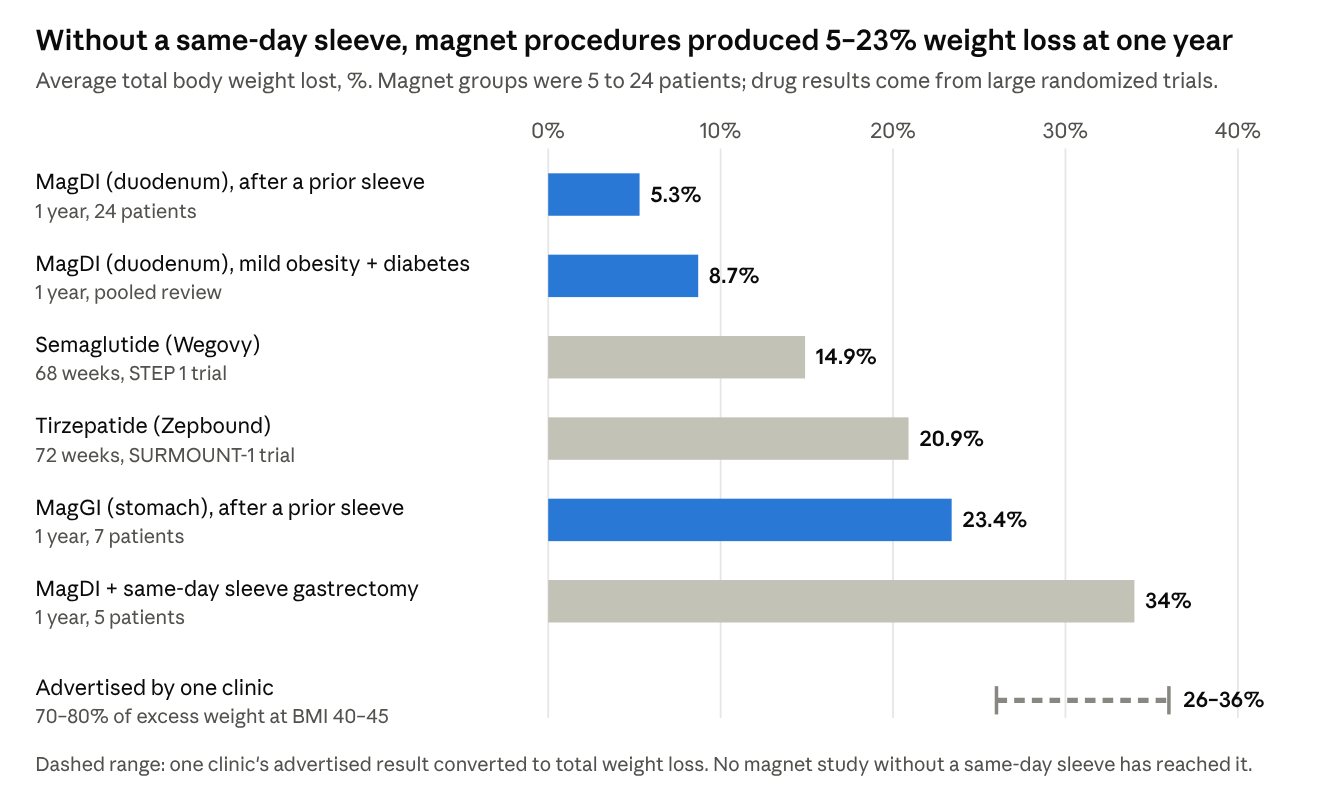
Sources: World J Surg 2024; J Am Coll Surg 2026; Surg Obes Relat Dis 2026 review; Obes Surg 2023; STEP 1 and SURMOUNT-1 (N Engl J Med). See References.
Complications: "no leaks" is perhaps a bit premature
Every published study reports no leak from the magnetic connection itself. A 2026 review of the duodeno-ileal studies counted no device-related leaks and no deaths within 30 days. But that review covered only 153 unique patients, and its leak figure rests on how each study's authors classified their own complications.
Serious complications still happen:
| Study | Patients | Serious complications reported |
|---|---|---|
| MagGI (stomach-to-ileum), 2026 | 20 | 9 patients (45%) had at least one serious event: 8 needing a procedure and 4 life-threatening. These included 2 bowel perforations with peritonitis needing reoperation, a reversal for uncontrollable diarrhea and vomiting, and magnets that never passed and were removed endoscopically at 5.5 months |
| Italian MagDI multicenter, 2025 | 28 | A small-bowel perforation the day after surgery; liver failure that required reversing the procedure at about 5 months; a hernia at an incision site |
| Gagner, MagDI revision after sleeve, 2024 | 24 | 4 complications serious enough to need a procedure or intervention |
| Gagner, swallowable MagDI magnet, 2025 | 15 | 3 complications serious enough to need a procedure or intervention |
| Gagner, MagDI with sleeve, 2023 | 24 | 3 serious procedure-related complications |
| Belgian MagDI series with sleeve, 2024 | 10 | Hospital stays ranged from 2 to 40 days |
To me, the stomach-to-ileum study suggests the "no leaks" safety claim should be put on hold pending more experience. There were some episodes in the studies that seem like red flags regarding a possible leak problem.
In one case, a patient came back with belly pain ten days after the magnets were placed. A CT scan showed leaked fluid and free air in the abdomen, which suggests a leak. They took the patient to surgery and found infection (peritonitis), another hallmark of a leak.
The only hole identified was a tear at their stomach-to-intestine connection. It’s exactly where we’d expect the device to leak if it leaked on its own. It was repaired.
The authors attributed the hole to their manipulations during the exploratory operation. Their account sort of glossed over the fact that the leaked fluid, free air, and peritonitis were already there before the operation began. The leak-suggestive findings were why they went to surgery in the first place.
The paper's summary reads: "No anastomotic leak or bleeding." Maybe there wasn’t. It is often hard to prove exactly what happened. I will say, however, that in most clinical reporting, this episode—a leak literally of the anastomosis—would be counted as an anastomotic leak.
A second patient developed peritonitis the day after the magnets were placed, from a perforation in the bowel loop leading into the new connection. The authors attributed it to the surgeon’s choice of graspers used to slide the magnets into place.
A few other points deserve an honorable mention:
- The magnets take weeks to pass. Across studies, they passed at an average of about 31 to 48 days, and up to 87 days in one patient. In one patient, they never passed and had to be retrieved with an endoscope.
- Malabsorption is a risk. Any operation that lets food skip the small intestine can cause protein malnutrition and vitamin deficiencies. A similar magnet device had a 9.3% malnutrition rate in the pooled review. In the stomach-to-ileum study, 40% of the first group developed mild nutritional deficiencies, and one patient was hospitalized for low protein. The liver failure case above is the kind of problem surgeons watch for after this type of bypass, whether the connection is made with magnets or staples.
- Dumping symptoms after meals have also been reported.
- Reversal is possible, but it is another operation.
The magnets are not an FDA-approved weight loss procedure
Some clinics advertise their magnet procedures for weight loss as "FDA approved." That representation is not quite correct.
In 2024, the FDA cleared the MagDI magnets as a tool for joining two parts of the intestine in general. It was not considered a weight-loss treatment. The FDA paperwork states plainly: "The effects of this device on weight loss were not studied."
Just like the surgical staplers, the magnets are tools. They can be used in weight loss procedures, but that use was not vetted by the FDA.
When the marketing outruns the data
Some practices are advertising results the published studies don't come close to supporting. One clinic markets its magnet procedure under a banner promising serious weight loss “without surgery.” It tells patients that most will lose 70 to 80% of their excess weight within 12 to 18 months.
There are multiple problems with that claim:
- "Without surgery" is not accurate. For starters, MagDI cases always entail general anesthesia and laparoscopic surgery. Placing the devices requires surgical instruments to work inside your abdomen to set things up. It’s surgery. Period.
- Magnet procedures alone haven't come close to 70-80% weight loss. Without a same-day sleeve, published results range from about 5% to at best 23% total weight loss at one year.
- The sleeve-like numbers come from patients who also had a sleeve. Many of the patients in the existing reports had a sleeve gastrectomy at the same time as the MagDI. Those patients did way better than MagDI alone; they had sleeve-like weight loss. For them, it seems logical to assume the sleeve did most of the work.
- There are no MagDI results at 18 months. The longest MagDI follow-up published is one year, in small groups of patients.
There’s nothing wrong with being excited about a new procedure. There’s nothing nefarious about believing in a new procedure. That said, we still owe patients accurate numbers.
Questions to ask before a magnet procedure
- Which connection will be made, and how much intestine will food bypass? Will I also have a sleeve gastrectomy? If not, what weight loss should I realistically expect?
- Do published data support the numbers you're quoting? How long were patients followed?
- Is the surgery you offer part of a clinical study, or is it routine care?
- What vitamin and protein monitoring will I need, and for how long?
- If the procedure needs to be reversed, who does it, and how?
- Is it covered by insurance, and what is the total self-pay cost?
The bottom line
Magnetic anastomosis is an interesting new way to make a connection in operations bariatric surgeons already know well. It doesn't change what those operations do. There’s no reason to believe they change the nutritional risks.
The "no leak" record should be regarded with skepticism for now. Those data came from a handful of small, industry-sponsored studies with obvious “skin in the game.”
Results track the operation the magnets recreate. The duodenum version alone produced modest weight loss, less than modern medications. The stomach version produced results similar to a stapled sleeve revision. Adding a sleeve produced standard-operation numbers. The risks track the operation too.
If you're weighing your options, we're happy to talk through all of them—the novel and the proven. Go to our website www.virginiabariatric.com to request a consultation.
References
- Gagner M, et al. First-in-human side-to-side magnetic compression duodeno-ileostomy with the Magnet Anastomosis System. Obes Surg. 2023. doi:10.1007/s11695-023-06708-x
- Gagner M, et al. Side-to-side magnet anastomosis system duodeno-ileostomy with sleeve gastrectomy: early multi-center results. Surg Endosc. 2023. doi:10.1007/s00464-023-10134-6
- Gagner M, et al. Side-to-side magnetic duodeno-ileostomy in adults with severe obesity with or without type 2 diabetes: early outcomes with prior or concurrent sleeve gastrectomy. Surg Obes Relat Dis. 2024. doi:10.1016/j.soard.2023.10.018
- Cadière GB, et al. Sleeve gastrectomy with duodenoileal bipartition using linear magnets: feasibility and safety at 1-year follow-up. J Gastrointest Surg. 2024. doi:10.1016/j.gassur.2024.02.001
- Gagner M, et al. Magnetic single-anastomosis side-to-side duodeno-ileostomy for revision of sleeve gastrectomy in adults with severe obesity: 1-year outcomes. World J Surg. 2024. doi:10.1002/wjs.12304
- Gagner M, et al. First-in-human side-to-side duodenoileal bipartition for weight loss and type 2 diabetes with the swallowable biofragmentable magnetic anastomosis system. J Am Coll Surg. 2025. doi:10.1097/XCS.0000000000001384
- Chiappetta S, et al. Creation of side-to-side compression anastomosis using the MagDI System to achieve duodeno-ileal diversion in patients with obesity: preliminary Italian multi-center results. Obes Surg. 2025. doi:10.1007/s11695-025-08409-z
- Nassar R, et al. Magnetic duodeno-ileostomy as a conversion procedure after sleeve gastrectomy: first single-centre experience in Colombia. Obes Surg. 2026. doi:10.1007/s11695-026-08973-v
- Gagner M, et al. First-in-human side-to-side linear magnetic compression gastroileostomy: feasibility and early outcomes in adults with obesity. J Gastrointest Surg. 2025. doi:10.1016/j.gassur.2025.102067
- Gagner M, et al. Linear magnetic compression gastroileostomy bipartition: feasibility and early outcomes. J Am Coll Surg. 2026. doi:10.1097/XCS.0000000000001926
- Noel P, et al. Duodeno-ileal magnetic compression anastomoses in metabolic surgery: a systematic review and meta-analysis. Surg Obes Relat Dis. 2026. doi:10.1016/j.soard.2026.08.020
- Wilding JPH, et al. Once-weekly semaglutide in adults with overweight or obesity (STEP 1). N Engl J Med. 2021. doi:10.1056/NEJMoa2032183
- Jastreboff AM, et al. Tirzepatide once weekly for the treatment of obesity (SURMOUNT-1). N Engl J Med. 2022. doi:10.1056/NEJMoa2206038
- US FDA 510(k) summaries for the GT Metabolic MagDI System: K242086 (October 2024) and K243359 (February 2025).
Footnotes
- I love that book. (I recommend the George C. Scott version of the movie!) ↩
- And who knows? Maybe it was tried somewhere. (*Cough* Brazil.) ↩
- Staplers certainly were very exciting for surgeons in practice in the 60s, 70s, and 80s. They freed up lots of time for golf, and golf was mandatory for surgeons back then. ↩
- They already had magnets in the 60s, by the way. ↩