
We’ve known for a long time that obesity is a risk factor for breast cancer. It raises the risk of developing the disease, and it independently worsens the odds of surviving it.
The survival problem is well established by the peer-reviewed literature. In a meta-analysis of 82 studies covering 213,075 breast cancer survivors, women who were obese before diagnosis had a 41% higher risk of death than women of normal weight. Every extra 5 points of BMI at diagnosis equated to an 18% higher risk of ultimately dying from breast cancer.[1]
That powerful drag on survival raises an obvious question: if a patient can lose the obesity, do they escape the extra risk? In a word, yes. Bariatric surgery answered the question for us two decades ago.
Large studies of breast-cancer diagnosis and outcomes among bariatric surgery patients have all yielded similar results. The best-known of such trials is the Swedish Obese Subjects Study (the SOS). Weight loss surgery reduced subsequent breast cancer diagnosis by 28-45%, and it reduced the odds of dying from breast cancer by 48-49%.[2][3][4][5] Observational evidence rarely gets more consistent than this.†
The clue hiding in the Swedish data
One of the most interesting findings in SOS was not the headline. When the investigators split the cohort by baseline fasting insulin, the entire treatment benefit sat on one side of the split. Women with fasting insulin levels above the median saw their breast cancer risk drop by more than half. For women below the median, it did nothing at all.[3]
This insulin observation suggests fat by itself isn’t the problem. The patients who started with lower fasting insulin were also morbidly obese. The cancer risk, it seems, does not come from adipose tissue so much as it comes from the metabolic derangements that often—but not always!—result from it.
The metabolic derangements include hyperinsulinemia, but also abnormal IGF-1 signaling, adipokine imbalance, chronic low-grade inflammation, and peripheral aromatization of androgens to estrogen. The surgery trials showed us that normalizing the metabolic state is what reduced the cancer risk. It follows that other interventions which do the same thing, surgically or otherwise, are a path to the same benefit.
Enter the drugs!
What the GLP-1 data show
At MD Anderson, Sukumar and colleagues identified 1,022 breast cancer survivors who received a GLP-1 receptor agonist and matched 810 with invasive disease 1:2 against 1,620 nonusers. Mortality in the GLP-1-treated group dropped an incredible 63% vs. the control group.‡
Other studies have shown similarly amazing results. A different, larger analysis by Sukumar’s group reported five-year drop in all cause mortality of 52% among GLP-1 users compared to non-users.[8] Another study published in JAMA Network Open found all-cause mortality dropped 65% among GLP-1 obese patients who were treated with GLP-1’s.[9]
It would be hard to overstate how eye-popping that drop is. A 52 to 65% reduction in mortality is nothing short of astonishing. If these studies’ findings are accepted at face value, it would be correct to say that GLP-1 receptor agonists are the most effective breast cancer treatment ever discovered!
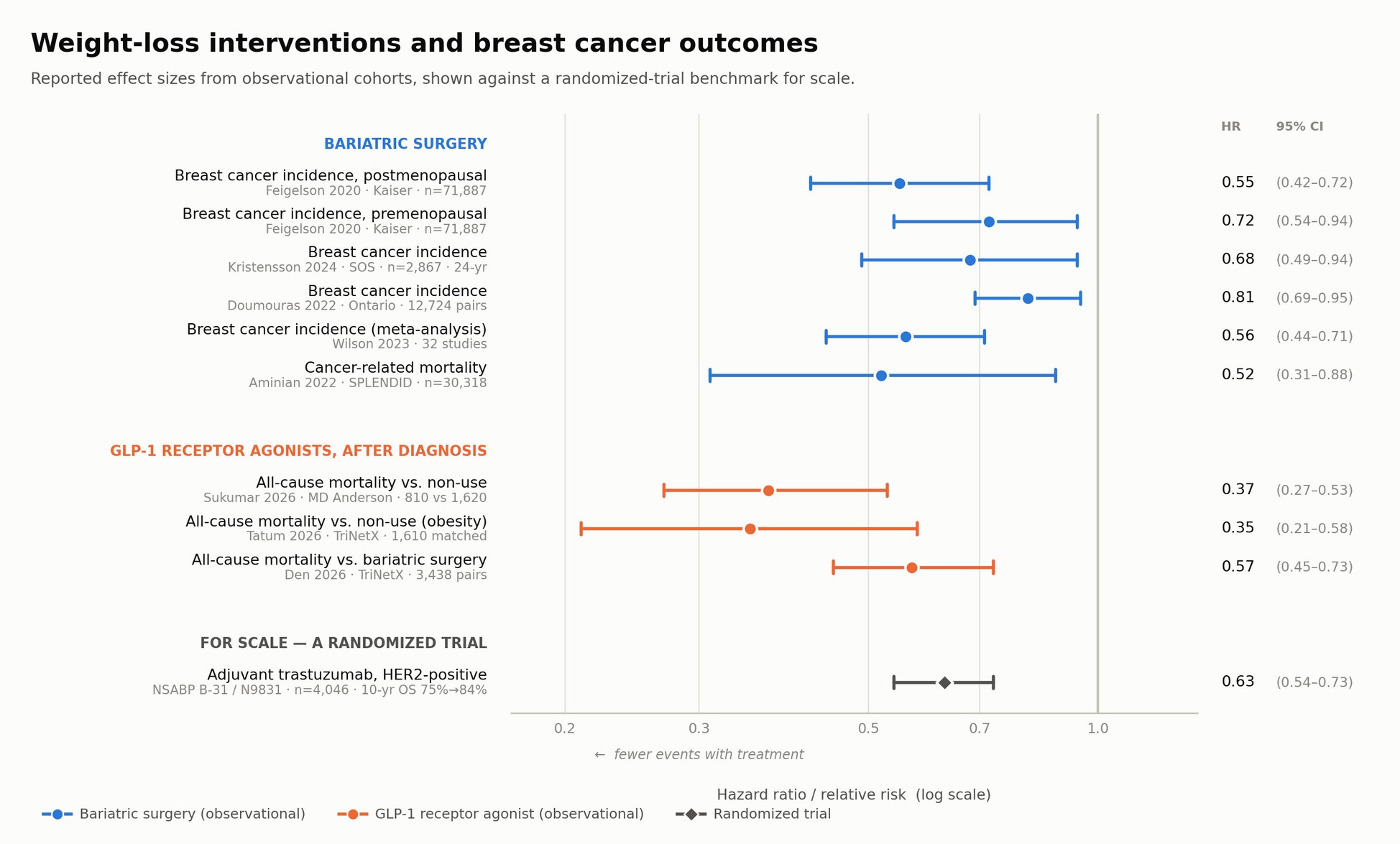
| Category | Study/Description | HR | 95% CI |
|---|---|---|---|
| BARIATRIC SURGERY | |||
| Breast cancer incidence, postmenopausal Feigelson 2020 · Kaiser · n=71,887 | 0.55 | (0.42-0.72) | |
| Breast cancer incidence, premenopausal Feigelson 2020 · Kaiser · n=71,887 | 0.72 | (0.54-0.94) | |
| Breast cancer incidence Kristensson 2024 · SOS · n=2,867 · 24-yr | 0.68 | (0.49-0.94) | |
| Breast cancer incidence Doumouras 2022 · Ontario · 12,724 pairs | 0.81 | (0.69-0.95) | |
| Breast cancer incidence (meta-analysis) Wilson 2023 · 32 studies | 0.56 | (0.44-0.71) | |
| Cancer-related mortality Aminian 2022 · SPLENDID · n=30,318 | 0.52 | (0.31-0.88) | |
| GLP-1 RECEPTOR AGONISTS, AFTER DIAGNOSIS | |||
| All-cause mortality vs. non-use Sukumar 2026 · MD Anderson · 810 vs 1,620 | 0.37 | (0.27-0.53) | |
| All-cause mortality vs. non-use (obesity) Tatum 2026 · TriNetX · 1,610 matched | 0.35 | (0.21-0.58) | |
| All-cause mortality vs. bariatric surgery Den 2026 · TriNetX · 3,438 pairs | 0.57 | (0.45-0.73) | |
| FOR SCALE — A RANDOMIZED TRIAL | |||
| Adjuvant trastuzumab, HER2-positive NSABP B-31 / N9831 · n=4,046 · 10-yr OS 75%→84% | 0.63 | (0.54-0.73) | |
Which is why an eyebrow must be raised
Let’s take a moment and put these numbers in context. Consider trastuzumab.
The discovery of trastuzumab was one of the greatest triumphs of modern oncology. Randomized trials in 4,046 patients established that trastuzumab, when added to adjuvant chemotherapy in HER2-positive breast cancer, lifted ten-year overall survival from 75.2% to 84.0%.[10] That’s a 35% drop in mortality.
For plain-old semaglutide to outperform trastuzumab would be shocking, to put it mildly. But to outperform it by a factor of two? It makes one wonder: hey, are we missing something?
GLP-1’s clearly do confer a real survival benefit on breast cancer patients. But having looked more closely at the studies, the benefit is probably less than what has been reported. The studies share sources of confounding error. For instance:
The disease-free survival didn’t move. In the MD Anderson cohort (the most carefully constructed of the lot) GLP-1 use was associated with markedly better overall survival, but not better disease-free survival.[7] If these drugs were suppressing tumors, recurrence would be expected to fall. It didn’t.
The finding makes you wonder whether the drug was really just reducing death from cardiovascular and metabolic causes. The breast-cancer population is at high risk of both. Lower overall mortality is a real and obviously valuable benefit, but it doesn’t support the idea that GLP-1’s somehow fight breast cancer.
Some of the results are hard to attribute to GLP-1 effects. For instance, in the JAMA Network Open study, GLP-1 users had an all-cause mortality hazard ratio of 0.09 against patients on insulin or metformin — a 91% mortality reduction. In my view, that datum says “people on insulin are sick” more loudly than anything it says about GLP-1’s.
In the same study, GLP-1 users’ mortality showed no significant difference from patients on SGLT2 inhibitors.[9] SGLT2 inhibitors don’t cause meaningful weight loss. The null result suggests GLP-1’s and SGLT2 inhibs both reduce mortality by reducing serious diabetes complications. It may be the most enlightening finding in the study, at least as far as the GLP-1-cancer question.
Securing a GLP-1 prescription is probably a marker of health. These drugs can often only be obtained by patients with good insurance, wealth, or both. Wealth actually is an independent predictor of lower all-cause mortality.[11]
Also, GLP-1 prescriptions introduce a selection bias. Some patients inevitably get diagnosed with breast cancer at a late stage. Patients who are sick with metastatic disease usually will not start on weight loss meds.
The takeaways
Weight-loss surgery has been shown to lower the likelihood of getting or dying from breast cancer. GLP-1’s have convincingly been shown to improve overall survival in obese people with breast cancer. Whether GLP-1 use has any direct effect on cancer biology has not yet been settled.
References
- Chan DSM, Vieira AR, Aune D, et al. Body mass index and survival in women with breast cancer — systematic literature review and meta-analysis of 82 follow-up studies. Ann Oncol. 2014;25(10):1901–1914. doi:10.1093/annonc/mdu042
- Feigelson HS, Caan B, Weinmann S, et al. Bariatric surgery is associated with reduced risk of breast cancer in both premenopausal and postmenopausal women. Ann Surg. 2020;272(6):1053–1059. doi:10.1097/SLA.0000000000003331
- Kristensson FM, Andersson-Assarsson JC, Peltonen M, et al. Breast cancer risk after bariatric surgery and influence of insulin levels: a nonrandomized controlled trial. JAMA Surg. 2024;159(8):856–863. doi:10.1001/jamasurg.2024.1169
- Wilson RB, Lathigara D, Kaushal D. Systematic review and meta-analysis of the impact of bariatric surgery on future cancer risk. Int J Mol Sci. 2023;24(7):6192. doi:10.3390/ijms24076192
- Aminian A, Wilson R, Al-Kurd A, et al. Association of bariatric surgery with cancer risk and mortality in adults with obesity. JAMA. 2022;327(24):2423–2433. doi:10.1001/jama.2022.9009
- Doumouras AG, Lovrics O, Paterson JM, et al. Bariatric surgery and breast cancer incidence: a population-based, matched cohort study. Obes Surg. 2022;32(4):1261–1269. doi:10.1007/s11695-022-05946-9
- Sukumar JS, Raghavendra AS, Pasyar S, et al. Weight loss patterns and clinical outcomes of GLP1 receptor agonists in breast cancer survivors. Cancer Res Commun. 2026;6(3):447–455. doi:10.1158/2767-9764.CRC-25-0554
- Sukumar JS, Niu J, Jackson I, et al. Real-world treatment patterns and mortality associated with GLP1-RAs in breast cancer patients. J Clin Oncol. 2026;44(16_suppl):629. doi:10.1200/JCO.2026.44.16_suppl.629
- Tatum KL, Dahman B, Stevenson A, et al. Survival and recurrence with GLP-1 receptor agonists in breast cancer. JAMA Netw Open. 2026;9(5):e2612133. doi:10.1001/jamanetworkopen.2026.12133
- Perez EA, Romond EH, Suman VJ, et al. Trastuzumab plus adjuvant chemotherapy for HER2-positive breast cancer: planned joint analysis of overall survival from NSABP B-31 and NCCTG N9831. J Clin Oncol. 2014;32(33):3744–3752. doi:10.1200/JCO.2014.55.5730
- Chetty R, Stepner M, Abraham S, et al. The association between income and life expectancy in the United States, 2001–2014. JAMA. 2016;315(16):1750–1766. doi:10.1001/jama.2016.4226